SOME CLAN CUNNINGHAM HISTORY
New information surrounding the start of Clan Cunningham can be found in “SCOTLAND & SHAKESPEARE’S THIRD PROPHECY: CLAN CUNNINGHAM EDITION“. This book recovers the long lost notes of Frederic van Bossen, which moves the start of Clan Cunningham back to the beginning of the 900s. Note the King Edition of Scotland & Shakespeare’s Third Prophecy does not contain as much detail as the Clan edition.

Cunningham is a territorial name which is found in Ayrshire. As with many Clan names, there are many theories surrounding the onomatology of our name, with many interpretations being fanciful. The most widely accepted is the name Cunningham means the “Home of Kings”. However, recently Derek Cunningham has proposed a new theory, which has support from surviving land records, that the name Cunningham originates from the Viking phrase Cun-Inges-Holme, which means King Inge’s Island. In the late 11th century King Inge was a Swedish King who brought Christianity to Sweden.
Unlike other interpretations, this translation is supported by surviving 12th century land records. This is further supported by studies that support the idea that Frisken is the Latin variant of the Swedish name Freystein.
Though many argue that the first to take the name Cunningham was Warnebald of Kilmaurs, or perhaps his son, Robert, who received a grant of the land of Cunningham in Ayrshire somewhere between 1160 and 1180, it has to be remembered that during the time of King Macbeth the primary branch of Clan Cunningham was forced to flee Scotland.
This was then followed by a very complex period, which lasted 150 years, where our ancestors lived for several generation in dispersed estates in Scotland, and the various lands they still controlled in the north and east of England. It was in one of these regions, near Alvingham Priory in Lincolnshire, that a Gilbert de Cunningesholme sold his rights to the Cunningesholme estate in the year 1185 to “William the son of Robert”. Who this William the son of Robert was is still unclear, but it could be the same William the son of Robert, who appeared in the records surrounding Kilmaurs church, and was perhaps wrongly identified as being the son of Richard de Moreville by later historians.
However, all these very important 12th century documents are preceded by a legend. According to the 17th century historian Frederic van Bossen, the Scottish lands of Cunninghame were first given to a Lord Kenneth, who was the brother of a Lord Malcolm, in the mid to late 10th century. This was well before the time of King Macbeth. Frederic van Bossen also states this Malcolm, the brother of this Kenneth, then took the name Frisken in adulthood. In other words, he was not born with the Swedish name Frisken, and he was not Flemish. However, Frederic van Bossen is clear this early 10th century Frisken was NOT the ancestor of Clan Cunningham. That claim belonged to his brother Kenneth. At this point there is a break of several pages, after which he then mentions the story of Frisken, the father of the legendary Malcolm who saved King Malcolm III of Scotland by hiding him under hay. From the prior description given in van Bossen’s book, it appears this Frisken was the son of Kenneth.
This new information, which we have obtained from Frederic van Bossen’s book, also creates the required space for the mysterious early 11th century Thane Toushin de Cunningham to now appear.
According to the foundation stories surrounding Clan Hay there was a Thane of Cunninghame in the period just prior to the reign of King Macbeth.
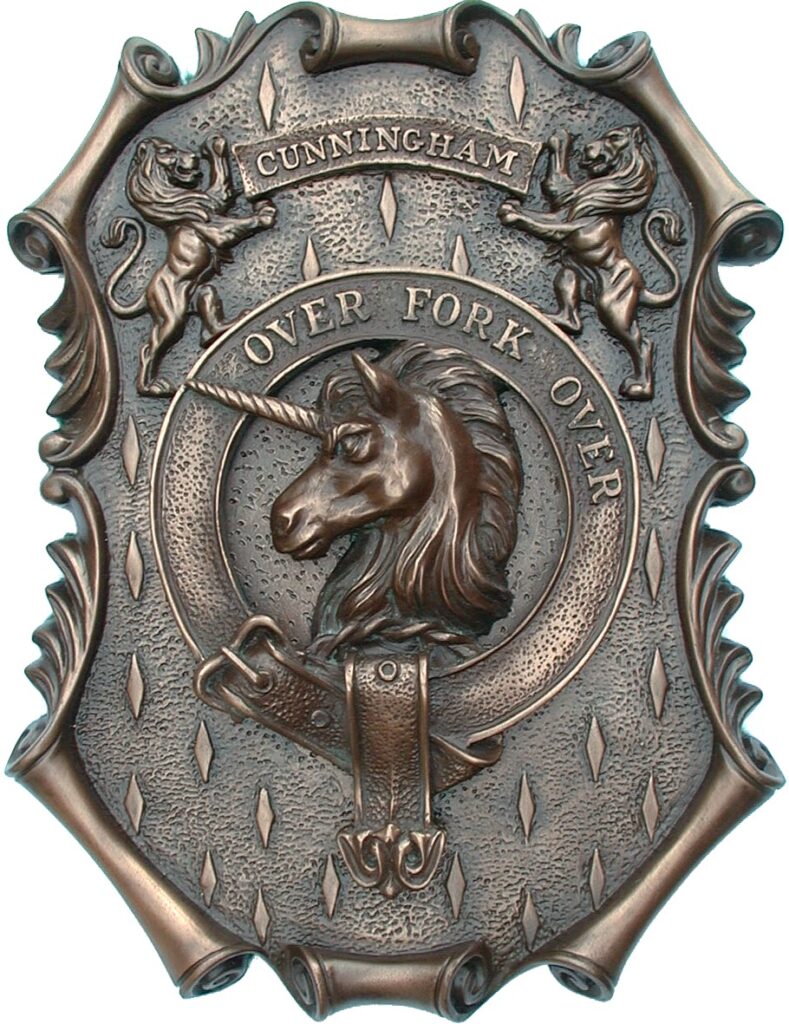
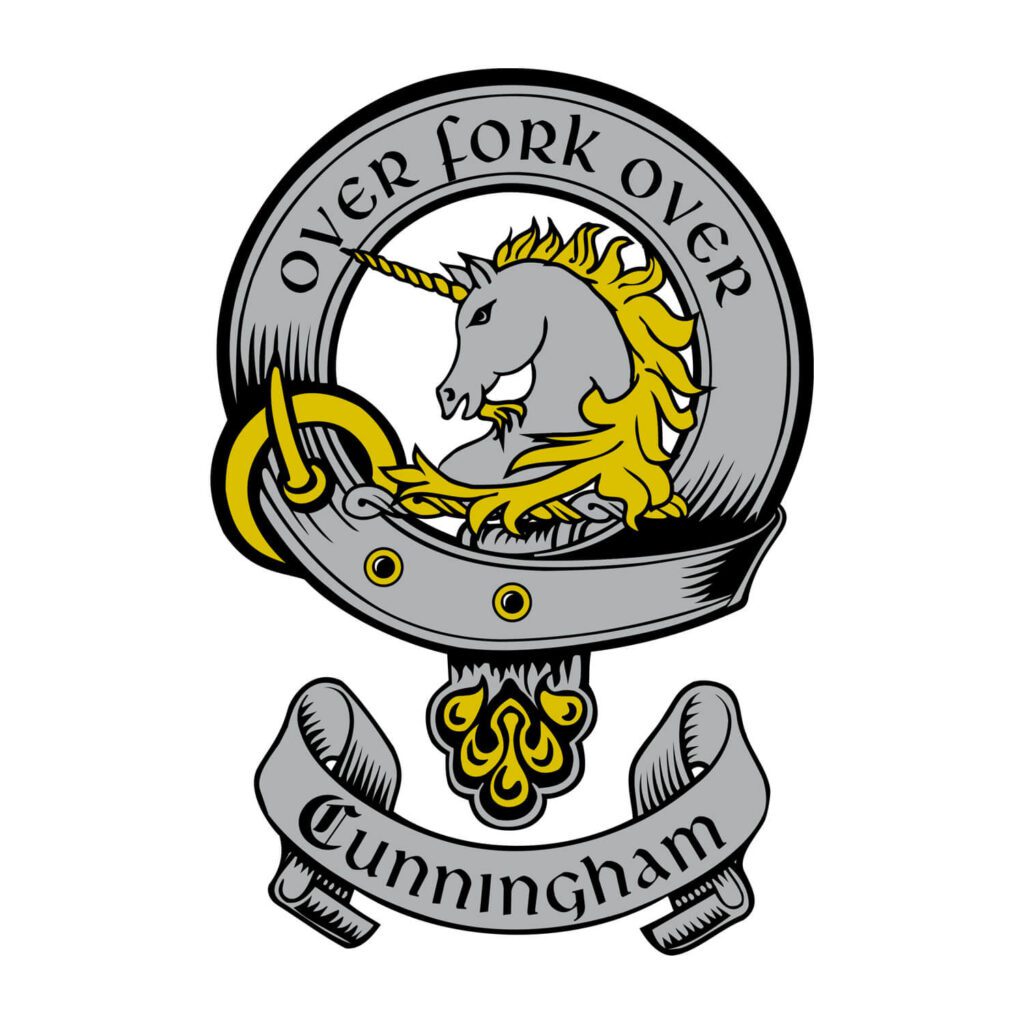
In Frederic van Bossen’s book, the author states the legendary Malcolm the son of Freskin was King Malcolm the Third’s Governor, and he rescued the young prince by sheltering him in a barn and covering him with hay (which might be a link to our clan’s link to clan de Hay). This story is then said to give rise to the shake-fork used in the Cunningham coat of arms and the motto, “Over Fork Over”.
In other interpretations, Sir George Mackenzie states with no supporting evidence that though this is a charming story, the Arms are actually a reference to the office of Master of the King’s Stables.
However, these two long-standing explanations can now be disproven, because it is now known that the Clan Cunningham’s Shakefork Y only came into use after the year 1540.
Prior to that the Clan Cunningham Coat of Arms was the Bishop Pall Y. In fact, the Clan Cunningham Coat of Arms is linked to the events surrounding Robert de Somercotes de Cunningesholme, who was Pope Elect for less than one day.
The Scottish records surrounding Clan Cunningham only substantially begin in the late thirteenth century. Hervy de Cunningham, the son of the Laird of Kilmaurs, fought for Alexander III against the Norwegian invaders at the Battle of Largs in 1263. As a result of this service he received from his King a charter of confirmation to all his lands.
The family were supporters of the Bruces in their fight for Scottish independence, , and the de Cunningham name appears on the Ragman Roll, which was made up of those swearing allegiance, under threat of death, to Edward I of England in 1296. As Robert the Bruce was generous to his supporters, the lands of Lamburgton were added to Kilmaurs (Hervy de Cunningham) by royal charter in 1319.
Sir William Cunningham of Kilmaurs was one of the Scottish noblemen offered to David II’s English captors as a substitute hostage in 1354. His son William married Margaret, the elder daughter and co-heiress of Sir Robert Denniston and through her acquired substantial lands, including Finlaystone in Refrewshire and Glencairn in Dumfriesshire. Sir William’s grandson, Alexander Cunningham, was made Lord Kilmaurs in 1462 and later in 1488 the first Earl of Glencairn.

A younger brother was ancestor to the Cunninghams of Caprington who were later to achieve prominence of their own. Other distinguished branches of the family include the Cunninghams of Cunninghamhead, Aiket, Robertland and Corsehill.
However, the fortunes of the family remained firmly in the hands of the main lineage, the Earls of Glencairn.
The fifth Earl, Alexander Cunningham, was a Protestant reformer and a patron of the reformer, John Knox. He has been accused of being in the pay of the English, who saw the Reformation as an opportunity to place the Scottish Crown in an embarrassing position. Regardless of the truth of this accusation, it is a fact that the Earl of Glencairn did rise against Mary Queen of Scots, and was one of the commanders at the Battle of Carbery Hill as a result of which Mary surrendered in 1567. This Earl of Glencairn is reported to have ordered the destruction of the Chapel Royal at Holyrood.
The Cunninghams also were among the Scottish undertakers of the Plantation of Ulster, and Sir James Cunningham, who was married to a daughter of the Earl of Glencairn, was granted five thousand acres in County Donegal. The Cunningham name is now among the seventy-five most common names in Ulster.